The Picasso Museum in Vallauris
, , by Riviera Guests
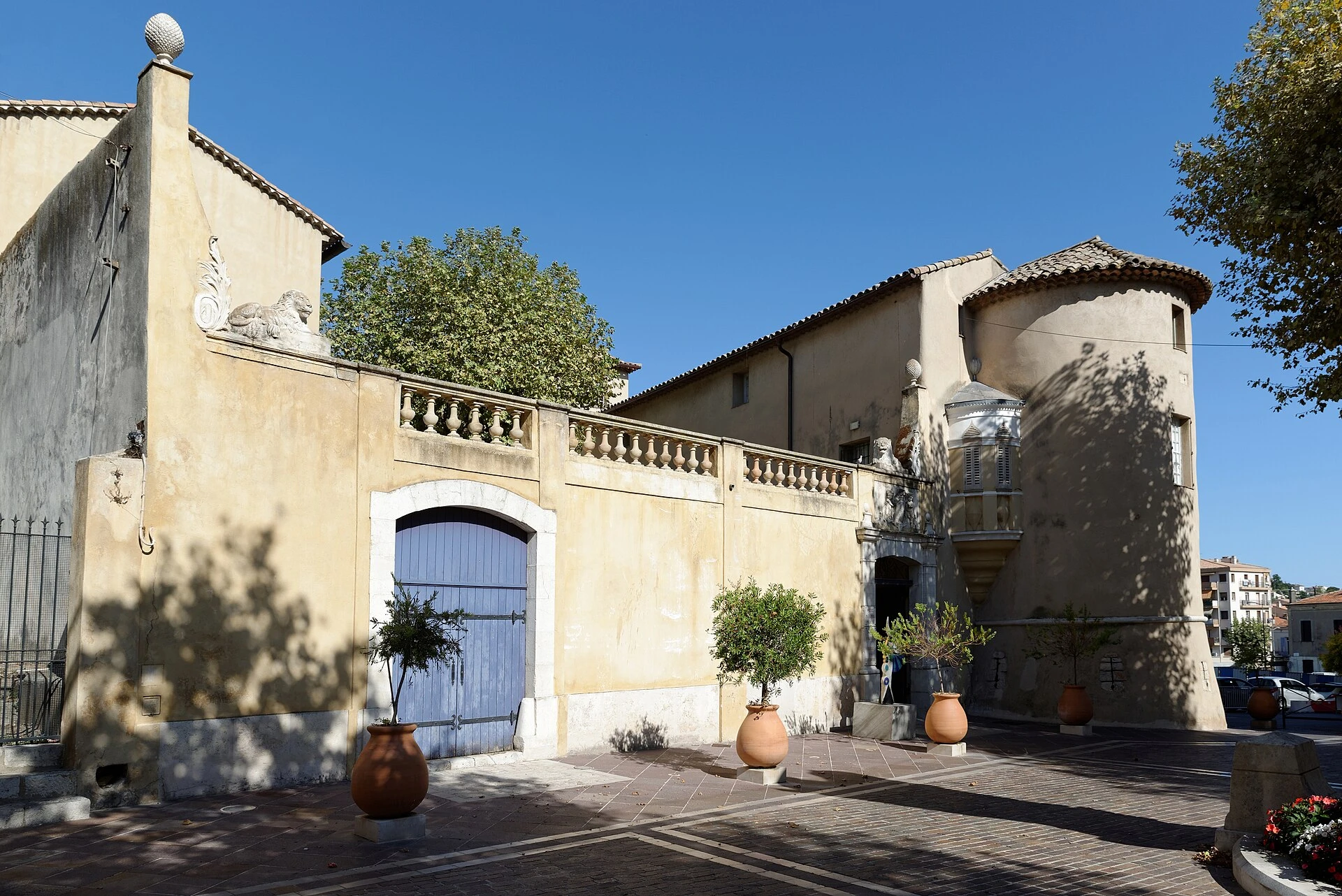
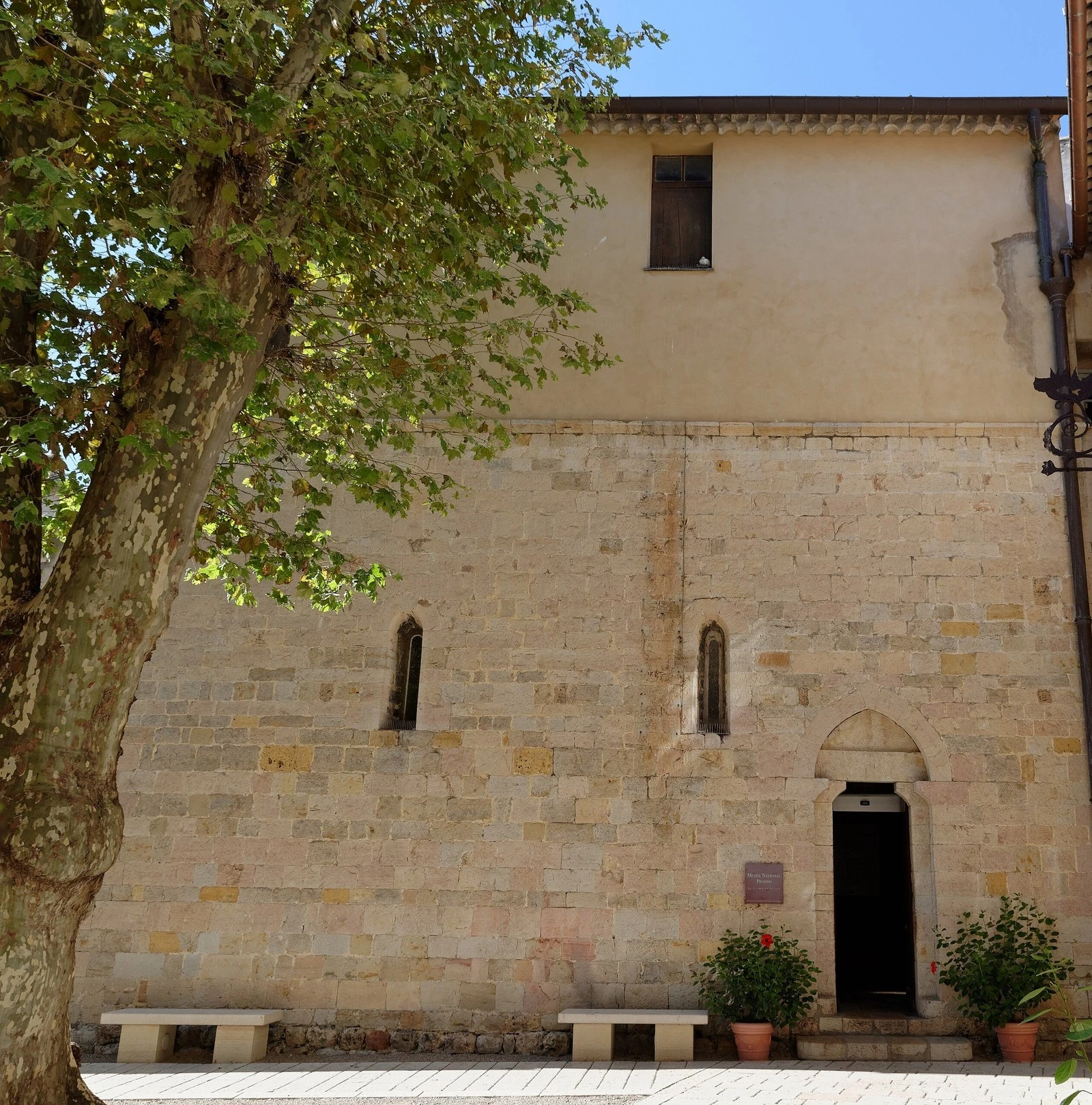
Beneath the vault of the Romanesque chapel at the Château de Vallauris, two panels, each 4.70 by 10.20 meters, face each other: War on one side, Peace on the other, painted by Picasso in 1952, midway through the seven years he spent in the town. Inaugurated as a national museum in 1959, the chapel shares its ticket with the Musée Magnelli, housed in the same château, while Man with a Sheep (L’Homme au mouton), the bronze the painter gave to the town, stands a few dozen meters away on Place Paul-Isnard.
Picasso lived in Vallauris from 1948 to 1955
Picasso discovered Vallauris in the summer of 1946, while on vacation in Golfe-Juan, and it was ceramics, the subject of another article in this journal, that most likely led him to settle there. In 1948 he moved into the villa La Galloise with Françoise Gilot, his partner at the time, and their son Claude; their daughter Paloma was born the following year, and he bought a former perfume factory, the Fournas, to use as a painting and sculpture studio. He left for Cannes in 1955, but came back in 1961 to marry Jacqueline Roque, in great secrecy, at the town hall that then stood on Place de la Libération, the very square where the château stands.
The chapel of the Lérins monks once served as an olive oil mill
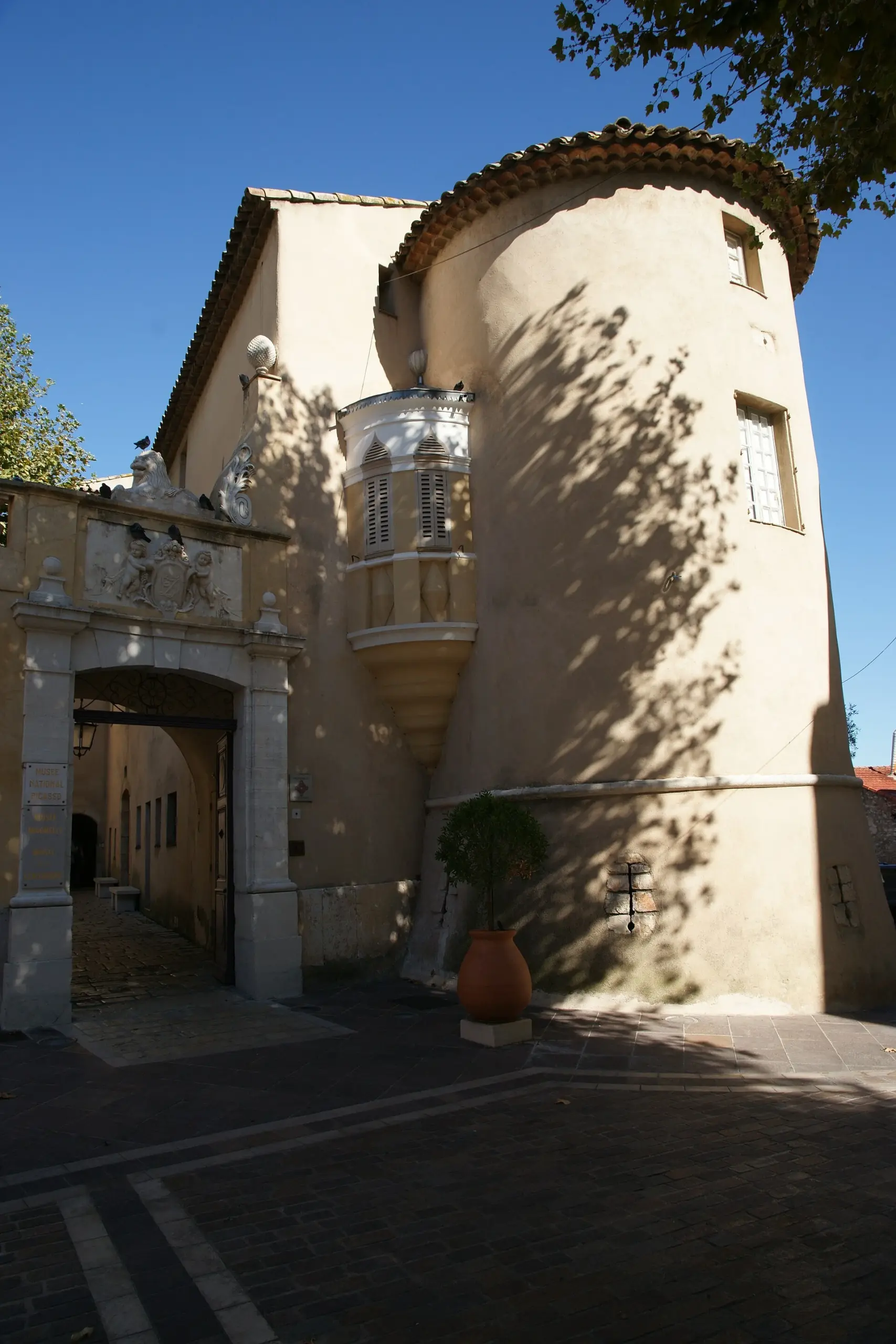
Lords of Vallauris from 1038, the monks of Lérins built a small castle and its chapel in the 12th century as a residence for their prior. While the château was rebuilt in 1568, the chapel has kept its nave under a pointed barrel vault, closed by a half-domed apse, and its walls of gray, pink and ocher stone. Sold as state property in 1791 and never returned to worship, it served for a time as an olive oil mill before being listed as a historic monument in 1951. That same year, the potters of Vallauris held a banquet there for Picasso’s seventieth birthday, and according to the tourist office the painter took the occasion to express his wish to decorate the vault and turn the old sanctuary into a “Temple of Peace.”
Picasso painted War and Peace flat in his Fournas studio
From April to September 1952, Picasso made some three hundred preparatory drawings, then painted the work at the Fournas on hardboard panels laid flat, a material flexible enough to follow the curve of the vault once installed. Before reaching the chapel, the two compositions were exhibited in Rome and Milan alongside Guernica and Massacre in Korea. They were installed there in 1954, and Picasso donated them to the French state in 1956 without their ever leaving the chapel, which was inaugurated as a national museum on September 19, 1959. A few days earlier, a third panel painted in 1958, The Four Parts of the World, had been put in place at the back of the chapel: its four figures, an image of harmony between peoples, block the old door that once opened onto the square.
Peace answers War from one wall to the other
On the first wall, a hearse drawn by caparisoned horses moves forward, driven by a horned figure with a bloodstained knife, and the hooves trample a book being consumed by flames. Facing the team stands a naked fighter for peace against a blue background, his shield bearing a dove, and beneath the dove, veiled by a glaze, the face of Françoise Gilot can just be made out. On the opposite wall, Peace reads from right to left: a woman nurses her child under a vine arbor, a child leads a winged horse pulling a harrow, two women dance to the double flute of a faun, and the painter amused himself by putting the birds in the fishbowl and the fish in the birdcage.
Picasso would have liked to leave the chapel in semidarkness: “I would like it not to be lit,” he told the writer Claude Roy, “for visitors to carry candles and walk along the walls as if in prehistoric caves.” In 1998, the on-site restoration required the panels to be taken down, and the wall revealed a charcoal drawing of a human figure, which the restorers photographed before covering it again when they put the work back.
Man with a Sheep has stood on the market square since 1950
Modeled in 1943, Man with a Sheep was cast in three bronze copies, two of which are now in Philadelphia and at the Musée Picasso in Paris. Picasso gave the third to Vallauris in 1949, and the town council’s resolution of October 21 records his wish “that one of his works should live among the people of Vallauris.” The statue waited in the chapel for the artist to choose a spot for it. That spot was the market square, since renamed Place Paul-Isnard, where nearly three thousand people, among them the poet Paul Éluard and Jean Cocteau, attended its unveiling on August 6, 1950, and the bronze thus became Picasso’s first sculpture placed in a public space, as he had wanted. Its theme recalls the Christian Good Shepherd, something Picasso denied: “It is not religious at all, the man could be carrying a pig instead of a sheep!”
The same ticket opens the Picasso rooms of the Musée Magnelli
Until November 23, 2026, the chapel is also showing “Poétique des mondes,” a project designed for the space by Pascale Marthine Tayou, an artist born in Cameroon. In the main body of the château, the Musée Magnelli devotes a route on its ground floor to Picasso’s years in Vallauris, and since 2022 its Suzanne and Georges Ramié room has brought together sixteen one-of-a-kind pieces that the painter dedicated to Suzanne Ramié.
Practical information
Musée National Pablo Picasso, La Guerre et la Paix, château, Place de la Libération, +33 4 93 64 71 83. September 16 to June 30, 10 am to 12:15 pm and 2 pm to 5 pm, last tickets at 4:30 pm; July 1 to September 15, 10 am to 12:30 pm and 2 pm to 6 pm. Closed Tuesdays, January 1, May 1, November 1 and 11, and December 25.
Tickets: €6, reduced rate €3, also valid for the Musée Magnelli, sold on site with no booking needed. Free for visitors up to age 18, residents of Vallauris Golfe-Juan, and for everyone on the first Sunday of the month.
Man with a Sheep: Place Paul-Isnard, outdoors.
“Dans les pas de Picasso” guided tour: Thursdays, 10 am to 12:30 pm, starting from the tourist office; booking required; €9, €6 for ages 8 to 18.
Getting there: A8 highway, exit 44 (Antibes), then follow signs to Vallauris; parking at Espace Loisirs and Hôtel de Ville. Envibus lines 5, 8, 17, 19 and 20, Place de la Libération stop; from Golfe-Juan train station, line 8.
Opening hours and prices as of October 2026; check before you go.
Where to stay: the Domaine des Encourdoules and the Villa Le Port d’Attache welcome guests a few minutes from the château
Three minutes from the museum by car, the Domaine des Encourdoules spreads its grounds of tall Mediterranean pines over more than a hectare, and from its lookout the view drops down to the sea and Cap d’Antibes, while below an orchard and vines rise in terraces. Agathe Freymann designed and decorated the guest rooms in an 18th-century sheepfold.
Five minutes away, the Villa Le Port d’Attache overlooks Vallauris between pine woods and fruit trees, with the sea on the horizon. Gillian and Daniel, who have traveled widely, named each of their rooms after a wind, and breakfast is served on terraces where a Provençal fountain murmurs.

Domaine des Encourdoules
Vallauris
Breathtaking view of Cap d'Antibes, over one hectare of parkland, guest rooms and an exceptional suite in the heart of a protected and listed site.

Villa Le Port d'Attache
Vallauris
Sheltered by the pines, panoramic view and dolce vita in Vallauris.
More places to discover on the French Riviera